Translate
Hephaestus Project- Great Image May 17, 2013 David Fuchs
- Creating a Brain Computer Interface Headband Using S.Q.U.I.D.’s … NOT! April 30, 2013 David Fuchs
- Just An Image To Take Your Breath Away April 19, 2013 David Fuchs
- Infinitely Expandable Computing Using Three Dimensional Configurable NAND Gates February 3, 2013 David Fuchs
- 3D Printing Of Houses And The Collapse Of Housing Prices January 27, 2013 David Fuchs
- OpenEI.org – Transparent Cost Database July 21, 2012 David Fuchs
- The Large Scale Renewable Energy Industry Is Living On Borrowed Time July 16, 2012 David Fuchs
- Chinese Tier-2 Photo Voltaic Modules Below $1/W February 22, 2012 David Fuchs
- The MPAA Is Again Trying To Exclude The Public From The Discussion On Copyright February 16, 2012 David Fuchs
- The Content Industry And The Five Stages Of Grieving February 16, 2012 David Fuchs
Archives
Meta
Great Image
Posted in Uncategorized
Leave a comment
Creating a Brain Computer Interface Headband Using S.Q.U.I.D.’s … NOT!
A SQUID’s (superconducting quantum interference device) is an electronic system that uses a superconducting ring in which one or two small insulating layers have been inserted. This device based on the Josephson effect in the superconductor-insulator-superconductor sandwich. The flux quantization in the ring makes it extremely sensitive to any magnetic field. Squids are so sensitive they can measure the magnetic activity of the brain in real time. The majority of squids rely on conventional superconductors that operate at liquid helium temperatures, -452.2 degrees Fahrenheit.
Fairly recently devices using the cuprate high temperature superconductors have come to market. With the creation of cuprate based SQUIDs the cooling requirements have been greatly decreased.
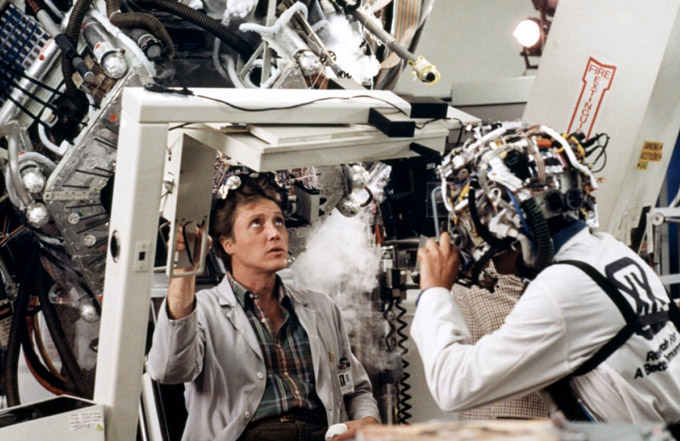
Using a SQUID as the sensors for a Brain Computer Interface (BCI) is not a new idea. The first time I saw this concept was in the 1983 movie Brainstorm, with Christopher Walken and Natalie Wood. The original unit they were using was a device the size of a refrigerator that you placed your head into. Its large size was due to the superconductors need to be cooled by liquid helium. Then a cinema plot device came into play, a superconducting chip that worked at room temperature, reducing the entire device to a consumer friendly, lightweight headband.
Todays exercise, creating a consumer friendly, light weight, SQUID based Brain computer Interface. Simple really …. if you look at it from an really odd angle. So it’s time to KISS KIM and do an engineering hack job on this puppy.
What do we need most to build a small lightweight BCI?
Small lightweight self refrigerating SQUID’s are the answer. I bet you knew that already.
The SQUIDs themselves are not the problem, they are manufactured using Integrated Circuit Fabrication technology, they a tiny little devices, just a couple micros across. Angels dancing on the head of a pin tiny, there are 25,400 microns in one inch. Lets ignore the SQUID for the time being, and concentrate on how to reduce the size of the refrigeration, associated insulation, and shrink it down so we can pack 20-30 of them in a headband.
To cool the SQUIDS there are four types of heat pumps to choose from, Compressor, Magnetic, Thermoacoustic, and Thermoelectric. Using a compressor is out, the weight, the voltage fluctuations, and the vibration all say poor design choice. Magnetic cooling is out the SQUID is trying to detect minute magnetic fields and this cooling method will interfere. Thermoacoustic, yeah right … no, on two counts, who wants a 20 – 40 piezo crystals vibrating on their head at high frequency all day, plus piezo crystals also give off minute EM pulses, making them unsuitable. That leaves only the thermoelectric heat pump.
Thermoelectric cooling uses the Peltier effect to create a heat flux between the junction of two different types of materials. Simply put you run DC current through it, and it pumps heat from one place to the other. The lowest temperature thermoelectric heat pumps work at is 100 degrees Kelvin. Which is wonderful because high temperature superconductors will work at temperatures up to 133 degree Kelvin.
<This was embarrassing, so it was removed>
After doing all the math I come up with a 10 stage thermoelectric cooling module, made from 4 distinct material types for the thermoelectric heat pumps, two inches deep and using 20+ watts each to cool down to 115 K, with water cooling for outermost layer of the heat pump. Which makes this an unworkable solution.
What a waste of half a day. While I have come up with a working concept, it is not a viable headband BCI unless you have a neck the diameter of a telephone pole and wouldn’t mind wearing a 15 or 20 pound hat all day.
Normally when I get an idea like this it has a workable solution. The only solution I see is higher temperature superconductors. Maybe I need a hollywood plot device…
I should contact Joe Eck over at superconductors.org and see if he actually has come up with room temperature super conductors running at 35 degree C …..yeah right, I will put that on the list right after, “contact the pyramid power guy and order a hat” ….
Posted in BCI, Brain Computer Interface
1 Comment
Infinitely Expandable Computing Using Three Dimensional Configurable NAND Gates
Building With DNA bricks
Recently an article on building with DNA bricks, reminded me of a concept I came up with over ten years ago, configurable 3 dimensional NAND gates.

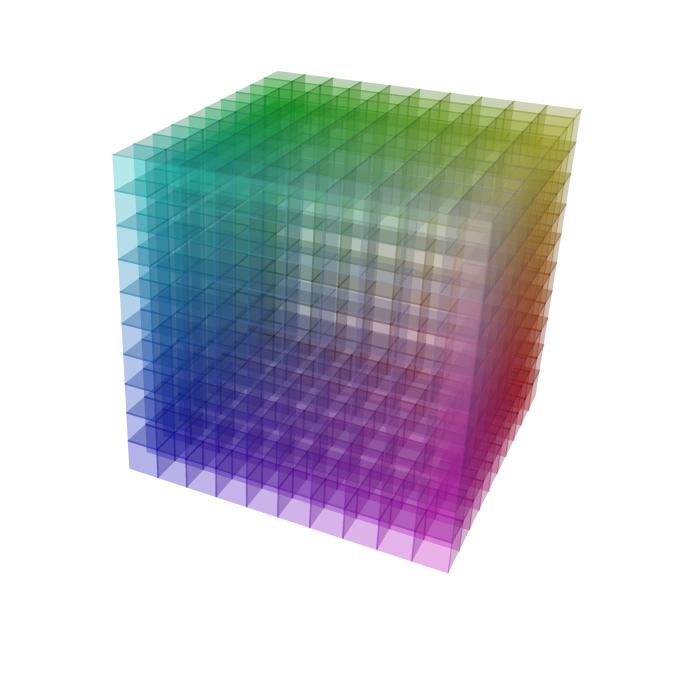
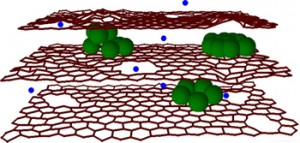
In the article (slideshow) they discussed using single strand DNA, to self assemble custom designed nano scale structures. Each of the bricks shown to the left is, 25-nanometers on a side, they are composed of ~1,000 voxels (I think it is 500 DNA strand, 2 voxels per strand) unique single strands of DNA, each with 32 nucleotides. Each strand is like a jigsaw puzzle piece and can only bind in one location. This is due to the fact that nucleotides only bind to their opposites, A to T and G to C. These DNA strands can be designed to self assemble into pretty much any shape, as shown in the image above.
This is where things get very interesting. This process does not just produce a single brick at a time, it creates as many as the available resources allow, all at the same time or over time. If you want a million identical bricks, you give it all the different varieties of single strand DNA it requires to create a million of them. Due to their small size you could create several billion in a shot glass.
A one inch cube could hold 1,000,000,000,000,000,000 of these 25 nm bricks.
n = (1 billion nm per meter / 25 nm / 100 cm per meter * 2.5 cm per inch)^3
Using two simple techniques, you can build much larger structures out of smaller ones. The first technique is to create binding sites, on each of the six sides of the brick. The second technique is to create a spacer-binder with matching but opposite nucleotides to bind to. Where A binds to T and G binds to C in the DNA sequences of the binding sites. When mixed these should self assemble into a larger structure.
Truth be told, to create a perfect cube like the one to the left, would take far more than just two different building blocks. It would take approximately 18.
Using just two different building blocks, one brick and one matching spacer-binder, you would end up with no limits as to how far, or in which direction the growth expands. The end result would be an amorphous blob, with an internally perfect lattice of bricks and spacer-binders. Since this is an article about, Infinitely Expandable Computing Using Three Dimensional Configurable NAND Gates, and not building the perfect cube shaped nano-processor, I will gloss over that point (amorphous blob) and get on with the article.
Three Dimensional Configurable NAND Gate
The NAND logic gate is the universal gate, with it you can build all other logic gates, NOT, AND, OR, NOR, XOR, and XNOR. By extension, using only NAND gates you can build any logic circuit imaginable, processor, memory, and any other logic circuit you can conceive of or need.
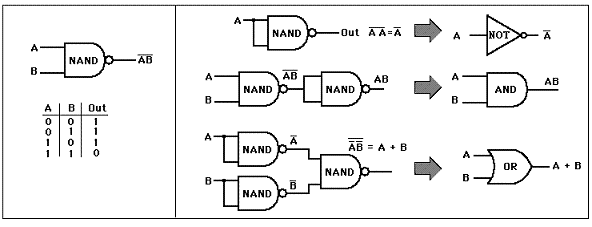
The concept for the Three Dimensional Configurable NAND Gate is simple. It is a cube with a NAND gate inside. The cube NAND gate has the following specifications.
- A cube NAND gate has six sides, each side can be individually turned on for input, output, or set as unused.
- A used cube NAND gate, must have at least one input and one output.
- When only one input is used, the gate acts as a NOT gate.
- All outputs of a single cube NAND gate output the same signal.
- A cube NAND gate can either be in use and logically connected to other cube NAND gates, or unused and not logically connect to any other NAND gates.
While this seems like a simple set of specifications it is really very powerful. It allows for any logic circuit to be configured, and any software to be run. In essence, by loading the logic for every chip in a computer system, and all the interconnections between those chips, it can become that system. It can become any processor Intel, Arm, Motorola, Zilog, IBM mainframe, Sun Sparc and run the software associated with those machines without any software conversion needed.
This is a wonderful thing, for people who wan to run old IBM reel to reel applications to impress their friends (snicker), but that is not it greatest strength. The true power comes from the fact that this makes software and hardware the same thing. Software becomes nothing more than the configuration of the 3D NAND array. This removes a huge amount of overhead, allows optimization in ways that can not be done on standard computer systems, and speeds up processing immensely for most applications.
Tying it all together, combing DNA bricks with configurable 3D NAND
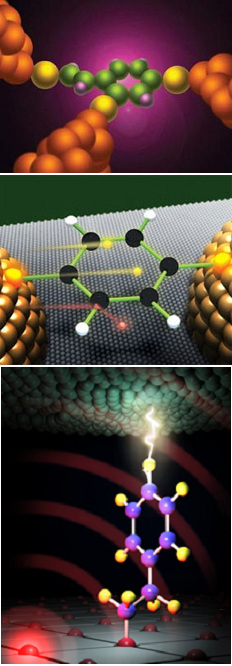
Over the past several years, transistors using small molecules (1) (2) (3) (4) (5) (6) (7) have been theorized, designed, and or built. There are currently under ten groups that have actually built and tested molecular transistors in the lab. Combining these molecular scale transistors, the ability to recognize and bind to molecules (Host Guest) precisely, and using DNA bricks and-or a technology like DNA Origami to transport the and place individual components, is what will allow us to create configurable 3D NAND gates. Adding spacer-binders to the mix, allows for the self assembly of individual 3D NAND gates into a large scale, infinitely configurable, nano-processor. The size of which should only be limited by the raw materials available.
Go large, or go home. Lets see what a 6 inch cube of configurable 3D NAND gates can do. First we need to know how many NAND gates fit into a 6 inch brick.
n = (1 billion nm per meter / 25 nm / 100 cm per meter * 2.5 cm per inch)^3 * 6 inches^3
n = 216,000,000,000,000,000,000 individual NAND gates. This does not take into account the spacer binders, the need for cooling, long range (> 1,000 nm) communications, and power, and I am going to ignore them because this is a speculative piece.
Note: adding all the missing pieces listed above takes about half the volume and ~halves the number of NAND gates, again we are ignoring that. Speculation, and just wanting to see roughly what can be done and all.
Totally Kludged Numbers Follow To Show What is Possible
With 216 x 10^18 gates, how many maxed out 8-Core Itanium Poulson, with max memory, and 1 Tb storage, can this emulate at once using a 6 inch 3D NAND brick. For this we are going to use worst case numbers for the gates. Each transistor on the Intel processor is going to be 3 NAND gates, all memory and storage will be 5 gates per bit. That is way overkill on both of them (see below).
To make the numbers even worse I am going to use transistor count on an Intel 8 core Itanium processor, instead of gate count, due to the fact that after an hour of looking, gate count was no where to be found. An Intel 8-Core Itanium Poulson has 3,100,000,000 transistors, a memory address space of 2^50 ( 1 petabyte ). Since an address space of 2^50, would require 125,000,000 of 8 gigabyte RAM modules, we will reduce that to something more reasonable, like 2 terabytes, or 250 8 gigabyte RAM modules. I am certain we can somehow shoe horn them into a actual rack mounted server, right next to the 1 terabyte hard drive.
The system consist of
- An Intel 8-Core Itanium Poulson
- 2 Terabytes of RAM
- 1 Terabyte hard drive
Now lets count the NAND gates needed.
Name Transistors-bits NAND gates per Item Total NAND gates
Processor 3,100,000,000 3 9,300,000,000
Memory 16,000,000,000,000 5 80,000,000,000,000
Hard Drive 8,000,000,000,000 5 40,000,000,000,000
Total NAND gates 120,009,300,000,000
We now know we need 128 quadrillion NAND gates to build the system specified above, and a 6 inch cube has 216,000,000,000,000,000,000 individual NAND gates. So lets see how many of these systems fit in or 6 inch box.
n = 216,000,000,000,000,000,000 / 120,009,300,000,000
n = 1,799,860.51
So in a six inch cube of 3D NAND we can fit ~1.8 million maxed out Intel 8 core systems.
Please take these numbers with a grain of salt, they are back of the envelope calculations just meant to show how much further we can go once this technology is available.
Afterword
While this is not currently possible to do. In very short order, the knowledge and techniques required to create these configurable 3D NAND gates will exist. The ability to selectively attach or bind to specific nano-scale structures or specific chemicals and move them into position, with atomic precision, will more than likely occur within the next 3 to 6 years. By combing the technology of DNA bricks and selective manipulation of nano-scale objects, devices such as the configurable 3D NAND gate can be constructed. This is just one small step away from full blown nanotechnology (Drexlerian or other).
The repercussions of this are profound.
3D Printing Of Houses And The Collapse Of Housing Prices
It occurred to me recently that within the next three to seven years there is going to be another crash in the housing market. This time it will not be caused by banks being over leveraged, real estate speculation, or the ineptitude of government. The cause will be new technology, and new manufacturing techniques. Use of technologies similar to Contour Crafting will reduce the cost of constructing a new home substantially. In many cases there will be a 60 to 85 percent decrease in the cost of a new home.
The resulting lower new home prices will devastate the existing homes market. Given the option people will more than likely purchase a home, custom printed to order, with 3 to 5 times the floor space, or opt for new home of the same size at greatly reduced cost. This great disparity in price will carry over to the banking sector, as existing homes become less desirable and difficult or impossible to sell. In the end, the likely results will be existing houses being sold for square foot price equivalent or below that of the newer 3 D printed houses. Over time 3D home printing technology will mature and becomes less expensive. Competition, optimization, and newer technologies will drive prices down even further. Leading to a reduction in new home prices over a period of several years. Towards the end of this downward spiral, many of the old existing homes, will more than likely be sold for their raw land value as people begin consider them boxy, ugly, inefficient energy guzzlers, and undesirable.

With 3 D printing, complex custom houses can be built for the same price, and in the same time, as simple houses with the same floor space. This will end the era of all houses in a development looking identical.
The banks carrying loans on existing homes, that were built by hand, will be dragged down as people opt to purchase new homes that cost substantially less, or have many times the floor space. No amount of government intervention will be able to repair the damage, or save the banks owning these mortgages. This will be a multi-year housing price depreciation, which will also place downward pressure on the prices of the first several generations of houses built using 3 D printing. This fall in housing prices will continue until the automated creation of houses has been fully optimized, and profit margins become extremely slim.
The banks can’t win this one, and neither can landlords. With the continued downward pressure on home prices, will also come a downward price pressure on rents. Landlords with existing rental properties, will find it extremely difficult to rent their properties at a profit, or sell the properties, bankrupting many of them as people move into newer, more efficient, prettier, and less expensive accommodations.
All in all, this one technology is going to cause a serious reallocation of wealth across the entire planet, destroying many current industries and creating many new ones.
Posted in Uncategorized
4 Comments
OpenEI.org – Transparent Cost Database

OpenEI.org has this wonderful resource for showing the costs of various energy technologies. The Transparent Cost Database covers Wind, Solar, Coal, Natural Gas, Geothermal, Hydro, Fuel Cell, Nuclear and shows cost projections out to the year 2050.
All of the long established technologies, coal, natural gas, nuclear, and geothermal have had their designs optimized as such the predictions of future costs are relatively accurate. For the newer technologies PV solar, thermal solar, fuel cell, wind, the numbers are already on the high side due to newer technologies and continuing research.
Posted in Power Generation
Leave a comment
The Large Scale Renewable Energy Industry Is Living On Borrowed Time

Governments and corporations around the world are adding large scale renewable energy to the power grid. The installations of huge solar and wind farms is growing, taking up large swaths of land. These farms cost hundreds of millions of dollars to install and maintain. They are engineering marvels, promoting a bright future without the pollution of coal, oil, or gas. They are slowly putting an end to the destructive trend of pumping carbon dioxide and other toxins into the atmosphere.
These projects are doomed to abject and total failure with in ten years. Have I got your attention yet?

Currently the economies of scale are on the side of large scale renewable energy producers. Bulk purchasing and installation, reduce the initial installation cost of Photo-voltaic, thermal solar, and wind farms. No current home windmill system can match commercial. The cost per watt goes down as the rotor size increases. The commercial cost per watt is well below what the average home owner would pay to have a system installed. The cost for a typical home PV installation is two to five times that of a commercial install. In the future the cost ration between utility scale and home installations is not predicted to change in any significant way.
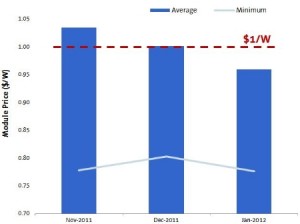
Over the past ten years the cost of PV solar modules has fallen from $18 to under $1 per watt. With the technologies currently being developed, in labs around the world, there is reason to believe this downward trend will continue. The price should reach 25 cents per watt by 2017. The forecast assumes the continued use of the same static flat panel design, that has been used for the past 30 years. If a design like MIT’s vertically zig zagged solar panel is combined extremely cheap, low efficiency (3%-5%) roll-to-roll process photo-voltaic cells. The cost per watt could be substantially lower. Bulk produced, on an automated assembly line, using extruded and injection molded plastic, the costs could be as low as 5 cent per watt by 2017, depending on design and complexity.
The cost of energy storage is holding back PV solar based energy solutions. There have been several technologies developed in the past few months that may change that.
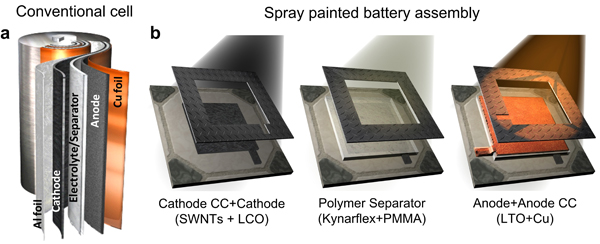
Rice University developed a spray painted lithium ion battery that is simple to produce and can be manufactured in any shape. If you wish to create a cylindrical battery paint it on the outside of a tube. If you want a battery in the shape of an apple print out the layers and stack them. Figuring out how to connect the layers is your issue.
Another interesting development is the development of a silicon spaced graphene battery electrode that can 10x the storage capacity of a lithium ion battery, and increase the lifespan of the battery by a factor of 10. According to the researcher, the technology could be seen in the marketplace in the next three to five years.
If combined these two technologies could potentially reduce the cost of batteries by a factor of 10, with a comparable reduction in battery size and weight. Combined with PV solar cells this technology changes the energy landscape of the planet. Low cost modular PV solar cells with energy storage become become possible. This should happen between 2017 and 2019.

Eventually we will reach a point where the cost to produce and store energy on the large scale and small scale meet. This is very counter-intuitive, until you realize that it takes years and tremendous capital outlay to build a large scale multi-megawatt solar farm, and a few thousand dollars and a couple hours or days to install a home system.
While the large scale producer is spending time and capital on a complex build out, the consumer already has a system installed. Even with continuously decreasing PV solar prices the large scale provider will still be running at a loss.
This is where the large energy producers strength, becomes their greatest weakness. The infrastructure they need to deliver energy to consumers. The cost of customer billing, meter reading, infrastructure construction, and maintenance, all become a severe drain on their once profitable business model. When the cost to create and deliver energy, is higher than the cost for a consumer to produce the energy themselves, the business of large scale energy production fails.
We are already at the beginning of this disruptive trend in Europe. Germany today has 25 gigawatts of consumer installed PV solar pumping energy into the grid. This has reduced the German daytime energy prices significantly. <click – (You really have to look at the before and after charts) Once prices drop on PV solar and energy storage, wide scale adoption is likely to occur. The bankruptcies of the least efficient and most leveraged energy producers will occur first, followed by the rest. My numbers say, this should start in the US around 2017 and end around 2025.

This trend will remove energy as a commodity and replace it with energy generation as the commodity. Between advancements in engineering and competition the cost per watt should fall until the underlying commodities prevent any further decline.
In the end it becomes buy once, remove the middle man, don’t pay for energy, use the system for 30 years, then replace it with a system with an even lower total cost of ownership and longer lifespan.
It is only a matter of time before it is more cost effective to generate you own energy, rather than buy it off the grid.
Perhaps I should have titled this article, “how the worlds energy companies will perish”.
Posted in Power Generation, Solar
7 Comments
Chinese Tier-2 Photo Voltaic Modules Below $1/W
The MPAA Is Again Trying To Exclude The Public From The Discussion On Copyright
After the protests and public outcry over SOPA, PIPA, and ACTA you would expect the MPAA to understand, it wasn’t just a few companies that were complaining, it was the biggest stake holder, the public. Now they are trying to exclude the people most affected by laws concerning open and free communications and make deals with a few corporations.
http://blog.mpaa.org/BlogOS/post/2012/02/16/Moving-Forward-on-Piracy-.aspx
The Content Industry And The Five Stages Of Grieving
For many people in the content industry its a way of life. The wheeling and dealing, the insider club, the exclusivity, once you get there you have a small group surrounding you. A group that you tend to stick with. That shares the same values, have their own dialect, and has the same faith in the way things have always been done.
Groups like this tend to strike out at anything that threatens their way of life. Religious, Political, and Social groups all do this. They rationalize their actions and believe anything, no matter how logically incorrect, to support their point of view. In order to maintain the coherence of the group they always find another group or a concept to demonize. For the longest time it was any sort of change, now their demon is the internet and they are using Google as its face.
If large enough these groups become stuck in a perpetual denial, anger, bargaining loop. The loop is driven by a meme gaining strength and giving hope, running its course through the group. Each time through the loop they push further, each time thinking this will fix the problem. The content industry has been doing this for 30 years now. The end result is the copyright in its modern form.
A Browser Plugin To Circumvent Googles New Privacy Policy Is Needed
Google is combining many of its 70 privacy policies into one that spans most of their internet properties. This is information they already have, now it is spread out over multiple websites. This will allow Google to track your online habits across most of its websites. Many individuals, privacy groups, the US government, and the EU are worried about this. This personally worries me on many levels. It allow the government a single place to find most, or if you are a heavy Google user like myself, all of your online habits. The more I look at this issue, the more I understand the privacy rights issues the Europeans are expressing.
The solutions given by Google are don’t use Google, sign out to not be tracked, and create a new account for each service. The last one is the interesting one, and offers a possible solution for most online tracking.
Browser plugins are applications that adds additional functionality to a web browser. What is needed is a plugin that does several things, securely stores users names and passwords for individual sites, logs you out of a site as you are leaving it, and protects your privacy. All of this functionality has already been created, and is available as individual opensource plugins on sourceforge.net. This needs to be combined into a single application, that clears both standard and flash based cookies, cleans up URL’s as you are browsing, logs you into and out of sites automatically, can be configured to prevents JavaScript from loading or running, and allows you to browse anonymously while logged out.
I will work on this in my spare time. When I am done coding this I will tweet it, post here, and contact techdirt, the EFF, and TorrentFreak.
The Epic Failure Of SOPA And PIPA – And What Everyone Doesn’t Seem To Realize Yet
Several hundred years ago, the transit times of books and news was extremely long, information spread at a very slow rate. Centuries ago for like minded individuals to come together, for a conspiracies to form, or for people to come to a consensus, it took years.
That has changed. We live in a time when information and news spreads at an unbelievable rate. Now you do not need to wait six months for a letter to reach you. It doesn’t take 3 months to travel to conference to meet face to face. Now you turn on your cellphone and text, tweet, or hit you Facebook or Google+ page.
Due to modern communications, we are seeing an acceleration of consensus, and a shortening of the time it takes for systems to be attacked for corruption or being overbearing. This trend is accelerating at an amazing rate. People are slowly beginning to understand this is occurring. Most people currently believe it is only a “don’t touch our Internet” thing. Silly people …
ABC News -“PIPA / SOPA and the Online Tsunami: A First Draft of the Future”
Augmented Reality And A TV Studio In You Pocket
For a while now it has been obvious that the effects done by TV and movie studios would eventually make their way to cellphones and tablets. This year at CES many of the cellphones and tablets on display had built in augmented reality apps.
We are rapidly approaching a time when everyone will have a TV studio in their pocket. One that allows editing of footage, CGI effects, and real time virtual sets. This is a seriously disruptive technology. All you will need is a copy of blender to create your sets, and you can film in any location on earth without ever leaving your home. The Over the next several years the TV and movie studios will face real competition from several billion people.
Posted in Disruptive, Technology
Leave a comment
TPPA – Trans-Pacific Partnership Agreement- Full
TPPA – TRANS-PACIFIC STRATEGIC ECONOMIC PARTNERSHIP AGREEMENT – FULL
The Cellphones Tablets and the Future of Hollywood
Independent movies don’t have to be block busters to ruin the studios. All they need to be is marginally successful. Already 10% of Sundance is Kickstarter funded movies. Imagine 10 years from now, when large numbers of movies are done by online funding through sites like Kickstarter.
Very soon technology will make it possible for anyone to make a good movie by drop, drag, and click editing. Cell phones and tablets will have access to every filter and transition possible, for little or no cost. Since every 18 months the same dollar buys double the computing power, cellphones and tablets will soon have the power to do real time CGI. This will allow people to create what ever content they can conceive of with little or no cost, except an investment in time.
This year at CES, we saw the beginnings of augmented reality on cell phones and tablets. Very soon we will see the ability to do real time virtual sets, and replace everything around a person with computer generated imagery. Once that happens the TV and movie studios have nothing going for them. Spending $100 million dollars on a movie will never be profitable, especially when competing with smaller more nimble competitors. They will be up against thousands of productions with better plot lines, less repetition of the same themes, and more targeted genres. The future of the studios does not look very bright.
The Party Of We – Communications in the world of good and evil.
This is the first in a series of essays on how communications and social media are changing the world. Several years back, large groups of people began spontaneously coming together online for various causes. There was however, no definition or description for these events, until Douglas Wood’s article “WikiLeaks Lessons: The Party of We — Already in Control”. In it he described telcom based flash mobs which he called “the party of we”. The party of we is united by a belief in cooperation, what is right, the truth, and freedom. This is the philosophical opposite of every corporation and governments on earth. We extends across every race, religion, national border, and political belief system and knows no sovereign authority.
The pen is mightier than the sword
The phrase the pen is mightier than the sword was coined in 1839 by an English author named Edward Bulwer-Lytton, in a play called Richelieu; Or the Conspiracy. This phrase is simple yet powerful it says, words have meaning, words can strike passion and fear in the hearts of men, words can change things, words can bring the truth forward, and words can give you hope. Never in history has this been more true than today. Much like a pen Facebook, Google+, twitter, LinkedIn, YouTube, and other social media, have this power. They speed messages along to friends, family, and people who have similar interests. Social media in all its forms allows us to create communities that span all national borders, all races, and all religions.
The growing trend of communicating and finding friends
Facebook and Google+ are the fastest growing communications firms on the planet. People using social media have the potential to influence and change the direction the world is headed. The ability to quickly find people who like, compliment, or believe the same things you do, is a growing trend in the world of telecommunications. Because of this trend you are no longer alone in the darkness. Heck, you could believe that fairies make the flowers grow, and you can find someone who believes the same. A simple cellphone and twitter, Facebook, Youtube, Google+, or just an email contact list can shine a light on the things that are good or evil in this world. Governments are beginning to take notice and fear their citizens, and this is a good thing. For to long it has been the other way around.
The acceleration factor of social media in promoting change
Communications and social media are becoming an accelerator of justice and societal change. In the recent past we have seen SOPA and PIPA crash and burn, the Occupy Wall Street movement, the Arab spring, Chinese human flesh search engines, the Tea Party, and Anonymous taking on large corporations and governments. These events did not happen spontaneously, they were all proceeded by years of corruption, abuse, or a growing discontent among those participating.
For several years now Techdirt has been reporting on ACTA, SOPA, PIPA, and the TPP. All these agreements were negotiated, created and lobbied for in secret, by the MPAA, RIAA, and USTR. Every attempt to gain access to the negotiations was denied. The US stated that the ACTA negotiations were secret and denied access to the document.
SOPA and PIPA crash and burn
SOPA and PIPA were written by industry lobbyists. When SOPA was brought up for discussion in the US House of Representatives Judiciary Committee, the entire proceeding was biased in favor of the content industry. The House Judiciary Committee admitted to not understanding the technology, then refused to hear from the “Nerds”. None of this was carried on broadcast news or in the newspapers, it was however vigorously debated online. The news of these bills spread far and wide crossing international borders. All valid concerns were ignored. It became obvious that the outcome was a predetermined, and the legislation was bought and paid for. Throughout these proceedings, the level of frustration and angry rose at the crony capitalism and corruption that were on display.
In protest of these bills Wikipedia, Reddit, and many other web sites went dark. Google censored its name in search. All of the sites directed people in the US on how they could contact their government representatives about SOPA and PIPA. The bills became toxic to be associated with. The president and many on both sides of the political isle dropped support of these bills, their passage into law almost impossible. Contrary to what the politicians and content companies believe, Reddit, Google and Wikipedia were not the cause of these protests, they were the catalyst. It was the 14 million people who responded, many of whom had read or participated in the online discussions about these bills, saying in one voice, enough already.
Arab Spring
The Arab Spring, is an ongoing uprising against several oppressive governments, that have repressed, tortured, and unjustly imprisoned their own people. In Iran, Tunisia, Egypt, Libya, and Syria, social media helped organize, focus, and accelerating these rebellions. It is probable that without the influence of social media, these events would have taken place, only at a latter date with greater casualty rates. The governments were unprepared and for these uprisings because there was no real warning and a relatively small portion of the population participated. These governments were prevented from fully using their military’s to engaging their citizens. The fear of being tried for crimes against humanity looms large in an age of citizen reporters and YouTube. Yet another win for social media and the party of we.
Conclusion …. hmmm ….
These events and occurrences have two things in common. The issues causing people to fight oppression, censorship, misdeeds, corruption, and wrong doing, have been there simmering for an extended period of time. The second is a catalyst which triggers a cascade of messages and the events that follow.
Telecommunications is playing an increasingly important role in these events. When oppression occurs, when a person cries out in the darkness, when a horrendous act happens, now all it takes is one individual to point it out to the world. Then, that occurrence can reach global attention in a matter of moments. This is something that should sober up every corporate board member, and head of state. Their words and actions are being discussed outside of channels that they control, and no amount of press releases can contain misdeeds. Social media accelerates the distribution of information, of news, of communications, and of consensus. Social media allows people who, in the past, would have never found each other in real life, to collaborate online. This allows like minds to come together quickly. Today people can organize around an idea in moments, an idea can take on a life of its own, spreading, and growing in ways that can not be anticipated.
Brought together by modern telecommunications, the party of we can be seen as a bunch of do gooding, protectors of the innocent, light in the darkness, ally to good, nightmare to the oppressor types(1). When We gathers applying real world crowd dispersal techniques does not work. Online you can not disperse a crowd, you can only move them outside of your realm of influence.
(1) A little tribute to Goku.
TPP – TPPA – Trans-Pacific Strategic Economic Partnership Agreement- Intellectual Property Chapter
Intellectual Property Chapter
Prior Restraint and the Closure of MegaUpload
Prior restraint is a simple concept.
A man owns a book store where half the books are evil, the other half are not. Because his stores inventory is half evil, it is shut down.
A man owns a book store with one evil book and forty thousand good books. Because of that one evil book, his store is shut down.
Prior restraint describes both of these cases. Both book stores were shut down, preventing access to the good, legitimate, and legal works. When in reality only the evil books should have been removed, and the stores allowed to continue doing business. Simple isn’t it?
The lead up is done, now the article …
Recently a web site called MegaUpload.com was taken offline by the FBI. MegaUpload.com was an online file hosting service where you could store your files and access them from anywhere with an internet connection. Many of the files infringed on copyright, but many others did not. This is a difficult conundrum, for a sizable portion of the 180 million users of this file service. If even 2% of them are not sharing files that are somehow are illegal, that means 3.6 million people have lost their files. What they see is this, with no ability to reclaim their files.
Now I ask a simple question. If one book in a store is good, and 40 thousand are bad, do you close down the book store, or do you remove the bad books and leave the one?
Before you answer. …. the Dictionary, A Tree Grows in Brooklyn, Death Be Not Proud, The Collected Works of Shakespeare, Kama Sutra, collected works of Ancient Greece, Bible, Koran, philosophy from Thales to Aristotle.
Welcome to the Internet, Please, do not Poke the Hornets Nest
Welcome to the internet. If this is your first day here let me explain some rules to you.
There are two billion of us here and we all talk to each other. So, don’t be a dick. Don’t come here with an agenda, we will sniff it out and tell everyone. It will not end up on the nightly news, but it will ruin your reputation. If you are here to spout talking points, we will ignore you. If you are here to astroturf a movement, push your political views, rally the masses towards your corporate agenda, feel free to try. No one will listen.
If you run a blog, allow everyone to comment, especially anonymously, and do not require moderator approval to post. Censoring comments, and having rules on what can, and can’t be said doesn’t go over well here. People have reputations and will self moderate.
If you have a social media page, allow people to express themselves, and respond to their comments and concerns. The nature of the internet isn’t the same as broadcast news. People expect interaction online, if they do not get responses they do not return. Do not create false comments online to present the image of being followed. It will be found out and fail.
Allow people to have their say and express their views. If you look out for people, are righteous, enlightened, and truthful, they will believe and believe and follow. In this place, we are not watching TV, we are interacting.
Remember, there are two billion of us here, once you lose our trust, it can never be regained, and you will not be remembered kindly. Please, do not poke the hornets nest, we are in here.
To The Nay Sayers …
Unknown origin
There are so many people out there who will tell you that you can’t. What you have to do is turn around and say “Watch me”.
Sappy I know, but it ended up in my quote of the day list.
Also : mousover the picture.
The Original Party of We Article
THE PARTY OF WE
Douglas Wood wrote a great article titled “WikiLeaks Lessons: The Party of We — Already in Control” on Law.com. This is one of those classic articles that begins to understand what is going on online.
The party of we is Anonymous, the Arab Spring, the 14 million strong protest over SOPA and PIPA. It is the growing separation between old news sources and online blogs, it is us finding, discussing and spreading news and ideas online.
This is a concept that I will expand and report on over time.
archived version
Posted in The Party Of We
Leave a comment
A Short Open Letter to the Content Industry
Dear Big Content
I recently heard that you said “that there would be no culture if there was no copyright monopoly.” I guess the library of Alexandria is a myth, there are no Greek tragedies, the Bible doesn’t exist, the Koran is a fairy tale, that fairy tales are recent fakes, philosophy from the times of Thales and Aristotle is one of my delusions, and we do not have extant literature from Sophocles and Euripides.
Thanks for clearing that up for me.
David
my comment on techdirt.com
Full Text of ACTA, TPP, SOPA and PIPA
In order to make an truly informed decision about (wikpedia links >>->) ACTA, TPP*, SOPA, and PIPA you need to read them. Everyone is talking about how these are internet-killing, speech-stifling, and how they will be abused. All this is true. In all actuality how many have actually read these bills, and trade agreements?
Here they are the actual texts for your perusal.
ACTA - Anti-Counterfeiting Trade Agreement (text)
TPP - Trans-Pacific Strategic Economic Partnership (text)
SOPA - Stop Online Piracy Act (text)
PIPA - PROTECT IP Act (text)
* The TPP is a leaked draft from 2011
Posted in ACTA, Bills Laws and Treaties, Copyright Clause, Future Legal Issues, IP, PIPA, SOPA, TPP
Leave a comment
A Quote From Thomas Jefferson That is Very Relevent Today
Quote:
“A wise and frugal Government, which shall restrain men from injuring one another, which shall leave them otherwise free to regulate their own pursuits of industry and improvement, and shall not take from the mouth of labor the bread it has earned. This is the sum of good government.”
Something to ponder … With all our governments, doing the exact opposite, what does that make them?